Navigate toolbar: [ Fish Diets | My Photos | Estuarine Research | FADs | Soniferous Fish | My CV | My Youtube | Children's Stories | Fish Facts | My Writings | Home Page ]
Soniferous Fishes Of Stellwagen Bank
Title: Identification of soniferous fishes on Stellwagen Bank: validation of their sound production characteristics and association of sounds with specific habitats and behaviors.
Principle investigators: Rountree, R.A., F. Juanes (UMASS-Amherst), and J. Blue (Leviathan Legacy, Inc., Orlando, Florida).
Funded by: National Undersea Research Program, North Atlantic &
Great Lakes ( http://www.nurc.uconn.edu/
)
Related publications
Rountree, R.A., and F. Juanes. 2010. First attempt to use a remotely operated vehicle to observe soniferous fish behavior in the Gulf of Maine, Western Atlantic Ocean. Current Zoology 56(1):90-99. View paper online
Burchard, K.A., F. Juanes, and R.A. Rountree. 2014. Diel reproductive periodicity of Melanogrammus aeglefinus in the southwestern Gulf of Maine. Transactions of the American Fisheries Society 143(2):451-466. View paper online
Rountree, R., Burchard, K.A., Goudey, C.A., Mouy, X. and Juanes, F. 2019. Passive acoustic monitoring of haddock in the Gulf of Maine: Preliminary results. In: Proceedings of Meetings on Acoustics 5ENAF 37(1):070011. Acoustical Society of America. View paper online
Rountree, R.A., F. Juanes, and J.E. Blue. 2003. Soniferous Fishes of Massachusetts. In: Listening to Fish: Proceedings of the International Workshop on the Applications of Passive Acoustics to Fisheries. April 8-10, 2002. Dedham, MA. MIT Sea Grant Technical Report MITSG 03-2. View paper online
Rountree, R.A., F. Juanes, and J.E. Blue. 2003. Potential for the use of Remotely Operated Vehicles (ROVs) as a platform for passive acoustics. In: Listening to Fish: Proceedings of the International Workshop on the Applications of Passive Acoustics to Fisheries. April 8-10, 2002. Dedham, MA. MIT Sea Grant Technical Report MITSG 03-2. View paper online
Sakas, C.J., C. Goudey and R.A. Rountree. 2005. Sanctuary Sounds – Monitoring underwater sounds in the National Marine Sanctuaries. Oceans 2005 MTS/IEEE View paper online
We conducted an inshore and offshore survey of soniferous fishes in the Gulf of Maine. The inshore survey was a preliminary study of soniferous fishes on Cape Cod from mid-June through October 2001 and obtained recordings of striped cusk-eel, striped searobin, oyster toadfish and other species. Based on the occurrence of vocal choruses, we found sunset spawning aggregations of the striped cusk-eels at eight of 12 locations sampled across the length of Cape Cod. This is significant because despite extensive faunal surveys in the region over several decades, the importance of the striped cusk-eels has been previously overlooked. This finding nicely demonstrates the usefulness of passive acoustics as a supplement to traditional survey methods. The seasonal and daily pattern of striped cusk-eel vocal activity agrees with published laboratory findings. We also conducted a successful passive acoustics survey of three habitat types within the Stellwagen Bank National Marine Sanctuary from October 17-24, 2001. Video data indicates a strong faunal difference among sand, gravel and boulder habitats. A preliminary review of acoustic data suggests that fish sounds were only heard in the boulder habitat. Strong circumstantial evidence suggests that the sounds recorded were from the Cusk, Brosme brosme. This is the first known recording of a vocalization of cusk in US waters, though Norwegian scientists may have recently recorded spawning sounds for the species. This finding is significant because it demonstrates that passive acoustics coupled with an ROV may be an important new tool to study the behavior and habitat use patterns of this little known and overexploited species. Extensive data on the noise characteristics of the ROV and support ship together with recordings of fish sounds will allow us to evaluate the feasibility of developing the Soniferous Fish Locator (SFL) device. Preliminary findings suggest that although the ROV is unexpectedly noisy, the ROV can be used as a platform for the SFL under certain conditions. Namely, that the ROV be stopped and held motionless on the bottom with all its thrusters shut down during signal acquisition and source bearing determination. Finally we have demonstrated for the first time that an ROV can be successfully used as a platform for the acquisition of passive acoustics data in conjunction with video data on fish presence, behavior and habitat type.
Quick Look Cruise Report - brief description of cruise results compiled during the cruise.
Photo gallery I photos from first cruise
Photo gallery II photos from
other
project cruises
Our resulting publication: Rountree, R.A., and F. Juanes. 2010. First attempt to use a remotely operated vehicle to observe soniferous fish behavior in the Gulf of Maine, Western Atlantic Ocean. Current Zoology 56(1):90-99. View paper online describes fish behaviors observed with the ROV and reaction of fishies to ROV noise. It also included the first published and validated recording of the cusk (not to be confused with cusk-eel). Go to Cusk sounds.
View a gallery of short video clips that supplement the paper
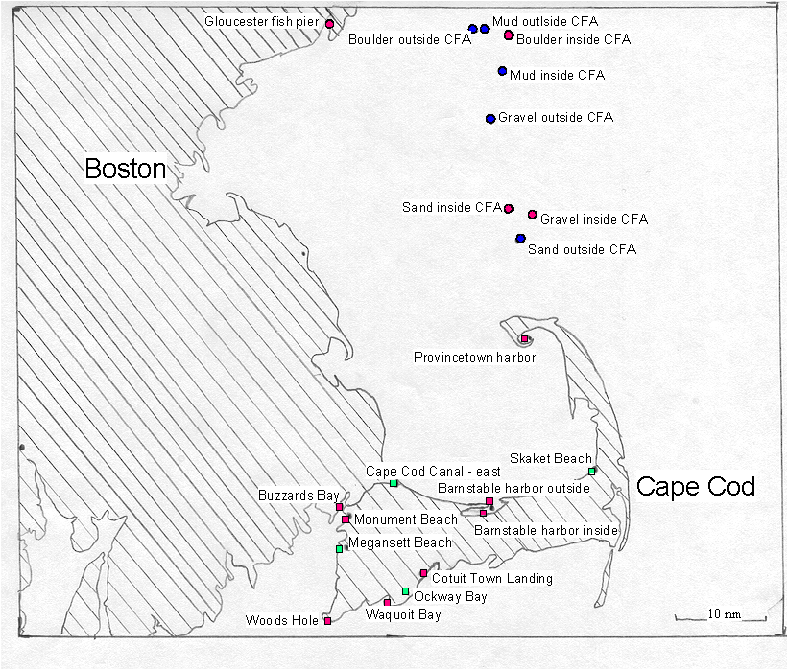
Figure 1. Location of inshore study site locations (squares) and
Stellwagen Bank Cruise Stations (circles). As part of the inshore survey of
fish sounds we sampled 12 locations (circles)
throughout Cape Cod at least once
between June and October 2001. Sounds of striped cusk-eels were recorded in
eight of the 12 locations (red circles), but were not recorded at Skaket beach,
Ockway bay,
Megansett Beach or the Cape Cod Canal (green squares). Seven of
eight potential stations were planned for the offshore cuise (red and blue
circles), however we were only able to sample three of
the stations due to
weather delays (blue circles). In addition, we sampled at the Gloucester Fish
Pier when our departure was delayed by weather.
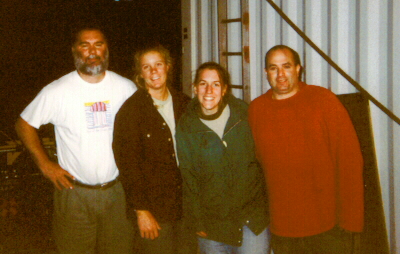 Science Party: Rodney Rountree, Meg Hendry-Brogan, Rebecca Jordan, and David
Howe.
Science Party: Rodney Rountree, Meg Hendry-Brogan, Rebecca Jordan, and David
Howe.
Return to: | TOP |
This page was last modified on December 11, 2001
Copyright © 2001 by Rodney Rountree. All rights reserved
Navigate toolbar: [ Fish Diets | My Photos | Estuarine Research | FADs | Soniferous Fish | My CV | My Youtube | Children's Stories | Fish Facts | My Writings | Home Page ]