Rountree, Rodney A., Francis Juanes, Clifford A. Goudey and Kenneth E. Ekstrom. 2012. Is biological sound
production important in the deep sea? Pp. 181-183. In: Popper, A.N. and Hawkins, A. (eds.) The Effects of Noise on
Aquatic Life. Springer Science+Business Media, LLC, New York. DOI 10.1007/978-1-4419-7311-5_41.
View paper online
Do deep sea fishes make sounds?
Introduction
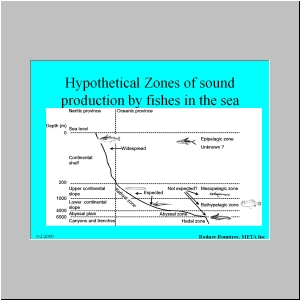
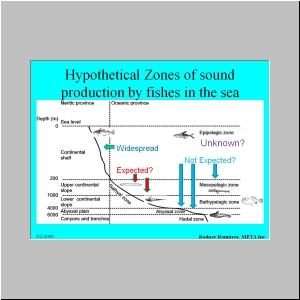
Over 50 years ago N.B. Marshall of the British Museum of Natural History hypothesized that biological sound production by fishes is widespread in the
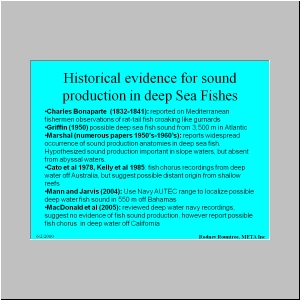
deep sea based on anatomical studies (Marshall 1954; 1967). Since that time only a handful of studies have reported observations of possible sound
production by deep-sea fishes based on acoustic recordings (Griffin 1950; Cato 1978; Kelly et al. 1985; McDonald et al. 2006; Mann and Jarvis 2004),
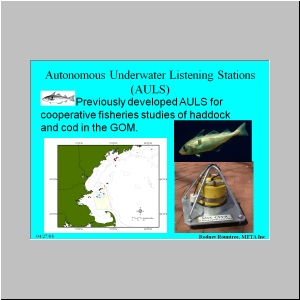
but no direct attempts to use acoustics to address Marshall’s hypothesis have yet been published (Slide 2-4). The failure of scientists to investigate the ecological
importance of deep-sea sound production has resulted partially from a lack of adequate low-cost technology (Rountree et al. 2006; Rountree 2008). As the
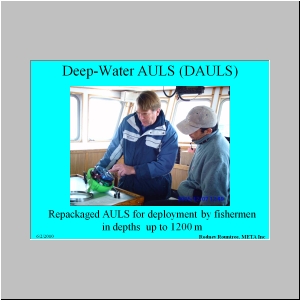
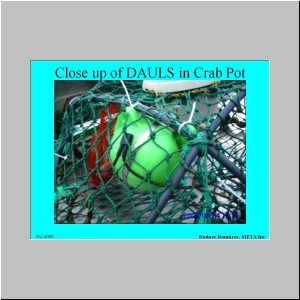
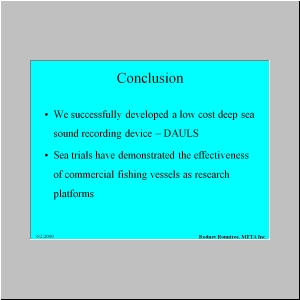
first step to begin to address Marshall’s hypothesis we developed a simple deep-water autonomous underwater listening system (DAULS) for use by ships of
opportunity, funded by a MIT Sea Grant College Program seed grant and in collaboration with commercial fishermen (Slide 5).
Methods
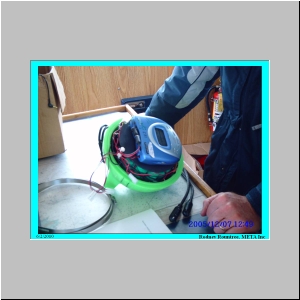
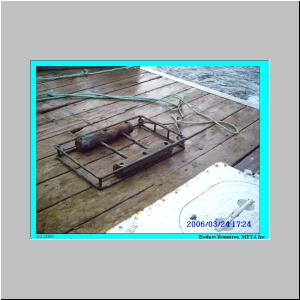
The housing for the DAULS was adapted from a deep-water trawl float (Panther Plast A/S, Vordingborg, Denmark) with a 1,800 m working depth that
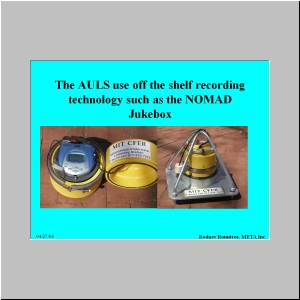
was split in half and fitted with an alignment groove and O-ring (Slide 8). The DAULS housing contained a Nomad Jukebox® (Creative Labs, Inc., Milpitas,
CA) digital recorder programmed to record continuously at an 11 kHz sampling rate for up to 60 hours (slide 9). The DAULS included two HTI-96-MIN hydrophones
(High Tech Industries, Gulfport, MS; sensitivity: Sensitivity -165 dB re: 1 V/?Pa, frequency response: 2 Hz to 30 KHz) mounted 1 m apart.
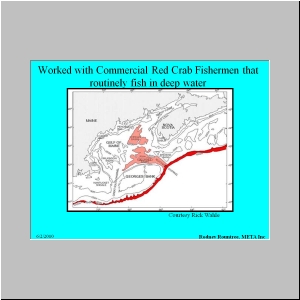
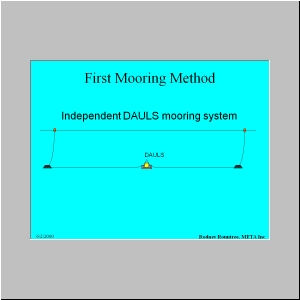
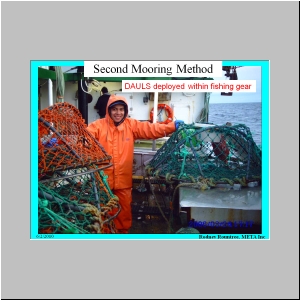
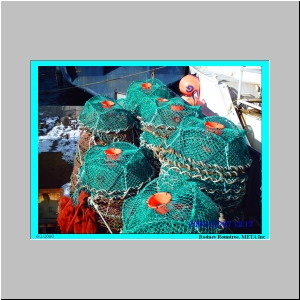
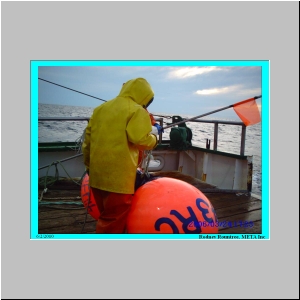
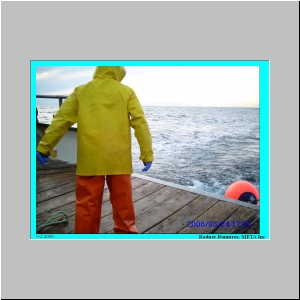
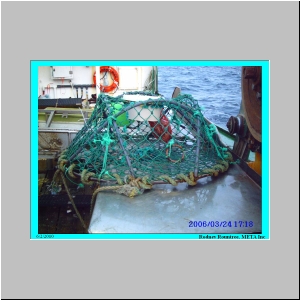
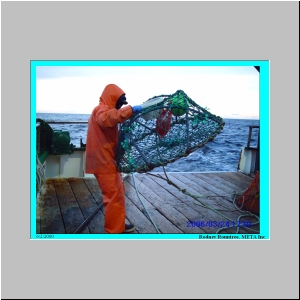
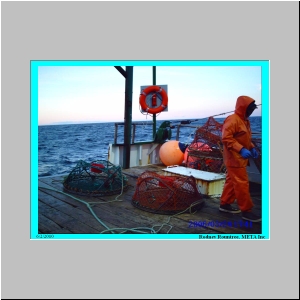
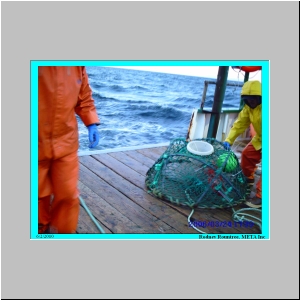
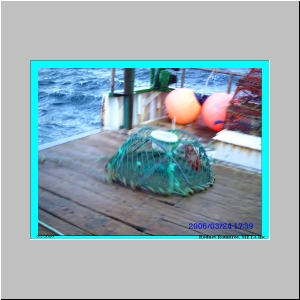
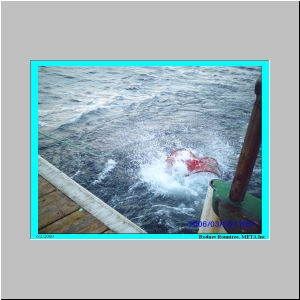
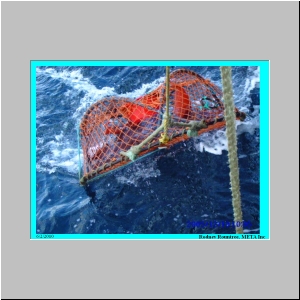
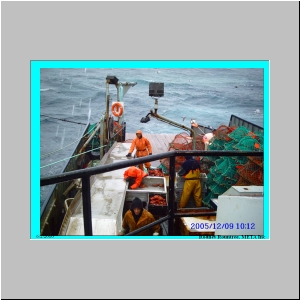
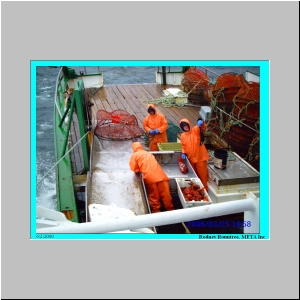
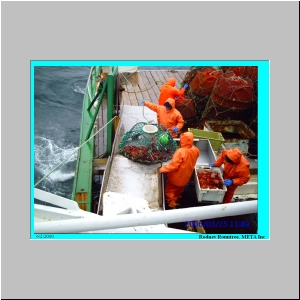
Fishermen deployed the DAULS inside a commercial deep-sea crab trap within a string of 100 traps during normal fishing operations along the shelf
break and retrieved it when the traps were hauled after approximately 24 hours (Slides 10-29). The spectral density of selected frequencies was determined at 15 minute
intervals over the deployment period using the method described by Locascio and Mann (2008). This method is particularly useful for detecting chorus
sounds. In addition, the entire recording was monitored by an observer to detect potential fish and other biological sounds.
Results and Discussion
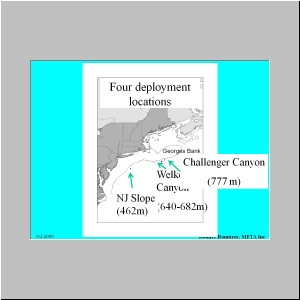
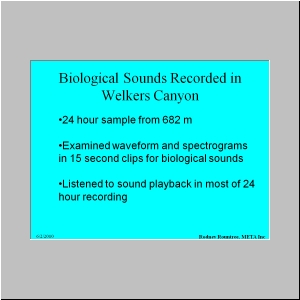
We successfully obtained a 24-hour recording on 18 October 2005 from the sea floor in 682 m of water in Welkers Canyon located south of Georges Bank
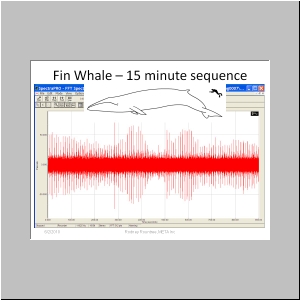
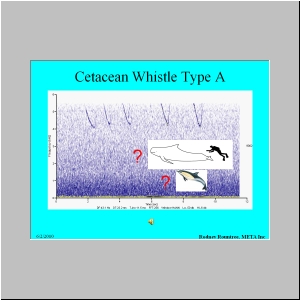
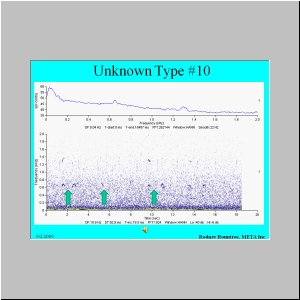
(Lat. N40.0883, Lon. W68.53167; slides 14, 30). The recording contained a wealth of biological sounds including sounds from fin whales, Balaenoptera physalus (slide 31),
humpback whales, Megaptera novaeangliae, pilot whales, Glopicephala spp., and dolphins (Delphinidae, slides 32), as well as frequent examples of at least 12 unique
unidentified sounds that we attribute either to undescribed cetacean or fish sounds. An examination of spectral density peaks within selected frequency
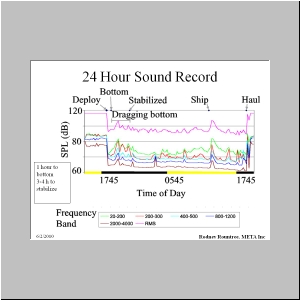
bands did not detect chorus activity (Slides 33-37). Peaks in low to mid frequencies resulted from periodic movement of the traps (dragging noise), while
peaks in higher frequency bands resulted from passing ships. Ships that passed nearby produced strong peaks at all frequencies and completely masked
biological sounds (Slide 41). Temporal patterns in received sound levels (slide 41) provided unexpected data on fishing operations. The DAULS took about an hour to
reach the sea floor, and then was dragged along the bottom for another four to five hours before coming to a stop, followed by periodic dragging
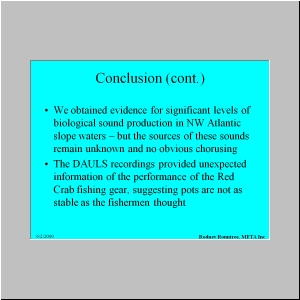
throughout the recording, thus contradicting fishermen’s assumptions of little trap movement after placement. Although chorus activity was not detected,
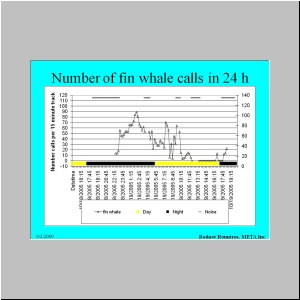
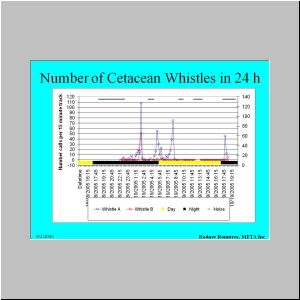
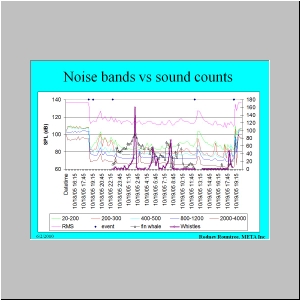
biological sounds exhibited strong temporal patterns (Slides 38-42). Low frequency (<30 Hz) fin whale (slide 38) and high frequency delphinid (3-5 kHz) sounds (slide 39)
dominated the recording and peaked at night. Unidentified calls could not be enumerated, but were present throughout the recordings, except when masked by ship
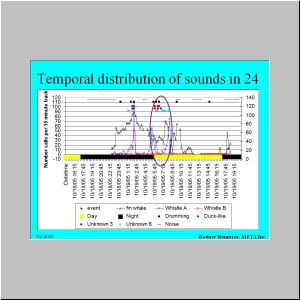
or dragging noises (e.g., gap just before 0500 h). Most individual biological sound types were infrequent, but several distinct sounds labelled
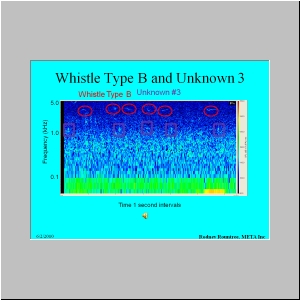
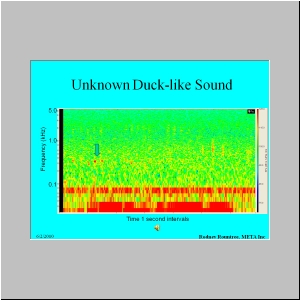
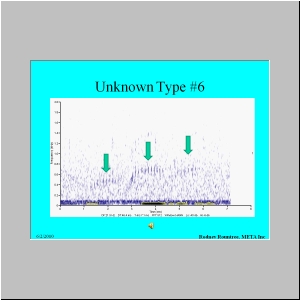
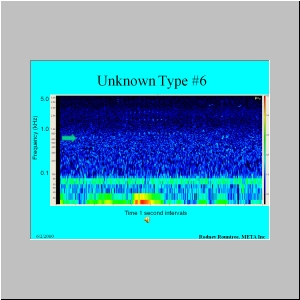
“drumming”, “duck-like”, “unknown 3”, and “unknown 6” occurred throughout the night and early morning hours (slide 40). Most unidentified sounds that
we attributed to biological sources had fundamental frequencies below 1200 Hz, well within the range expected for fishes. However, at this time we have
insufficient data to distinguish between fish sounds and undescribed low frequency cetacean sounds. In addition we noted that most of these sounds
exhibited very low received source levels and were often difficult to detect above the background noise.
Conclusions
More than 50 years after Marshal hypothesized the importance of sound production in deep-sea fishes, we still have little understanding of the
importance of fish sounds and the undersea soundscape in the ecology of the deep sea. However, our observations suggest that sound production by
deep-sea fishes is likely to be important. Further, if deep-sea sounds tend to be low amplitude as suggested here, then continued increases in
anthropogenic noise may be particularly problematic.
Jump to a list of related publications
Below are slides from a seminar on the project. Click on slides 32-27 for links to represented sounds, or go to the list of sounds
that follow.
List of sounds from the slideshow
References
Cato DH (1978) Marine biological choruses observed in tropical waters near Australia. J Acoust Soc Am 64(3):736-743.
Griffin DR (1955) Hearing and acoustic orientation in marine animals. Deep-Sea Res 3(Suppl):406-417.
Kelly L, Kewley DJ, Burgess AS (1985) A biological chorus in deep water northwest of Australia. J Acoust Soc Am 77(2):508-511.
Locascio JV, Mann DA (2008) Diel periodicity of fish sound production in Charlotte Harbor, Florida. Trans Am Fisher Soc 137(2):606-615.
Mann DA, Jarvis SM (2004) Potential sound production by a deep-sea fish. J Acoust Soc Am 115(5):2231-2233.
Marshall NB (1954) Aspects of Deep Sea Biology. Philosophical Library, New York.
Marshall NB (1967) Sound-producing mechanisms and the biology of deep-sea fishes. In: Tavolga WN (ed) Marine Bio-Acoustics. Volume 2.
Pergamon, Oxford, pp 123-133.
McDonald MA, Hildebrand JA, Wiggins SM (2006) Increases in deep ocean ambient noise in the Northeast Pacific west of San Nicolas Island, California.
J Acoust Soc Am 120(2):711-718.
Rountree RA, Gilmore RG, Goudey CA, Hawkins AD, Luczkovich J, Mann DA (2006) Listening to Fish: Applications of Passive Acoustics to Fisheries
Science. Fisheries 31(9):433-446.
Rountree RA (2008) Do you hear what I hear? Future technological development and needs in passive acoustics underwater observation.
Mar Tech Rep 51(9):40-46.
Since this study I have participated in several related studies:
Wall, C.C., R.A. Rountree, C. Pomerleau and F. Juanes. 2013. An exploration for deep-sea fish sounds off
Vancouver Island from the NEPTUNE Canada ocean observing system. Deep-Sea Research I 83:57-64.
View paper online
Wall Bell, C.C., R.A. Rountree and F. Juanes. 2016. Mapping the Acoustic Soundscape off Vancouver Island Using the NEPTUNE Canada Ocean Observatory.
Chapter 151. Pp. 1205-1211. In: A.N. Popper, A. Hawkins (eds.), The Effects of Noise on Aquatic Life II, Advances in Experimental Medicine and Biology 875,
DOI 10.1007/978-1-4939-2981-8_151
View paper online
Aguzzi Jacopo, Chatzievangelou Damianos, Marini Simone, Fanelli Emanuela, Danovaro Roberto, Flögel Sascha, Le Bris Nadine, Juanes Francis, De Leo Fabio,
Del Rio Joaquin, Thomsen Laurenz, Costa Corrado, Riccobene Giorgio, Tamburini Cristian, Lefevre Dominique, Gojak Carl, Poulain Pierre-Marie, Favali Paolo,
Griffa Annalisa, Purser Autun, Cline Danelle, Edgington Duane, Navarro Joan, Stefanni Sergio, Company Joan Batista, D’Hondt Steve, Priede Imants G.,
Rountree Rodney. 2019. New high-tech flexible networks for the future monitoring of deep-sea ecosystems. Environmental Science & Technology 53(12): 6616-6631.
View paper online
Riera, A., Rountree, R. A., Agagnier, L. And Juanes, F. 2020. Sablefish (Anoplopoma fimbria) produce high frequency rasp sounds with frequency
modulation. The Journal of the Acoustical Society of America, 147(4), pp.2295-2301.
View paper online
Aguzzi, J., Chatzievangelou, D., Thomsen, L., Marini, S., Bonofiglio, F., Juanes, F., Rountree, R., Berry, A., Chumbinho, R., Lordan, C. and
Doyle, J., 2020. The potential of video imagery from worldwide cabled observatory networks to provide information supporting fish-stock and
biodiversity assessment. ICES Journal of Marine Science, fsaa169, https://doi.org/10.1093/icesjms/fsaa169
View paper online
Rodney A. Rountree, Jacopo Aguzzi, Simone Marini, Emanuela Fanelli, Fabio C. De Leo, Joaquin Del Rio and Francis Juanes. 2020. Towards an Optimal
Design for Ecosystem Level Ocean Observatories. Oceanography and Marine Biology - An Annual Review Vol. 58:76-106.
View paper online
Declan McIntosh, Tunai Porto Marques, Alexandra Branzan Albu, Rodney Rountree, and Fabio De Leo. 2020. Movement Tracks for the Automatic Detection of
Fish Behavior in Videos. Tackling Climate Change with Machine Learning Workshop at the 34th Conference on Neural Information Processing Systems (NeurIPS 2020).
View paper online
Return to: | TOP |
This page was last modified on
March 1, 2021
Copyright © 2011-2021 by Rodney Rountree.
All rights reserved
Navigate toolbar: [ Fish Diets |
My Photos |
Estuarine Research |
FADs |
Soniferous Fish |
My CV |
My Youtube |
Children's Stories |
Fish Facts |
My Writings |
Home Page ]